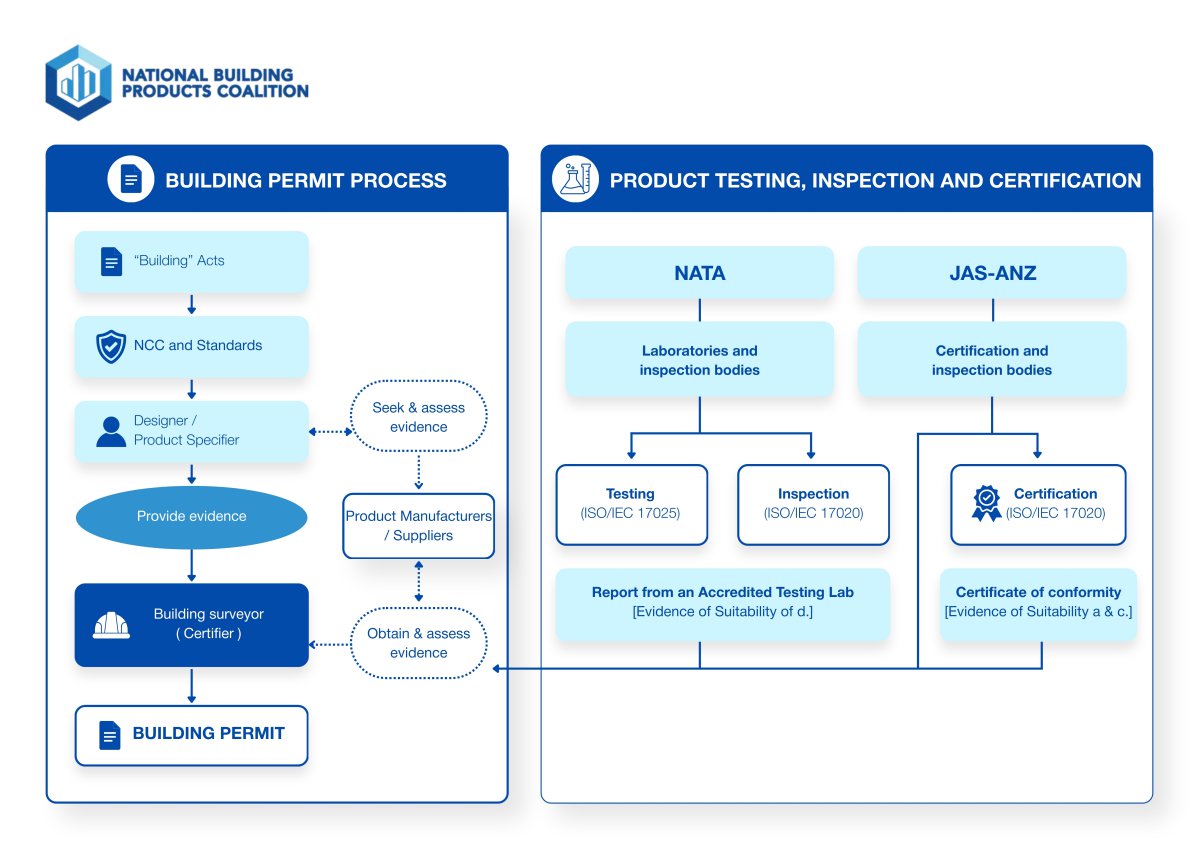
In Australia accreditation to undertake testing, inspection and certification is provided by the Joint Accreditation System of Australia and New Zealand (JASANZ) and the National Association of Testing Authorities (NATA).
The value of accreditation is immense as it allows for trusted impartial validation and declaration of the competence of the bodies undertaking the testing, inspection and certification, which are subjected to audits and the potential for sanction by the accreditation body.
CAB’s can provide product conformity schemes offering different levels of assurance and ongoing surveillance (known as scheme Type). CABs will perform their function according to the Type of scheme, the rules contained within it and their scope of accreditation. Some schemes are government owned, such as CodeMark and WaterMark, while some are owned by private organisations and industry bodies. Some may be Australian based, while others are international.
When selecting a scheme to undertake the assessment, or when reviewing the assessment results, the rigour and transparency provided by the scheme Type should be evaluated to ensure it is appropriate to the level of risk associated with the products used in the building.
In addition to a certificate issued under CodeMark Australia Pevidence of suitability pathway NCC A5G3 (1) [a.], if evidence is to be established through a certificate from a certification body, as per evidence of suitability pathway NCC A5G3 (1) [c.]., they must be accredited by JASANZ. If relying upon a report from an Accredited Testing Laboratory Pevidence of suitability pathway NCC A5G3 (1) [d.], (the laboratory needs to be accredited by NATA or an organisation outside Australia accredited to undertake the relevant tests by an authority recognised by NATA through a mutual recognition agreement).
The NCC will often reference standards through prescriptive provisions against which products can be assessed to determine if they are fit for purpose. In some cases, however, new and innovative products are developed for which no referenced standard is available. In these circumstances, the NCC provides pathways for product innovation through impartial analysis to determine if it is fit to be used for its intended purpose and against which provisions it is assessed as performing to. This process, which should be performed by an accredited CAB, needs to establish evidence of compliance with nominated NCC Performance Requirements and scope of use (including any limitations).
In securing appropriate product conformance information, it must be remembered that the purpose is to provide the registered building surveyor/certifier, who has responsibility for determining whether to issue a building permit, the appropriate evidence of suitability (test reports, certificates or other product information) that can be verified to confirm how specified products perform and comply with the NCC and the relevant Australian standards.